
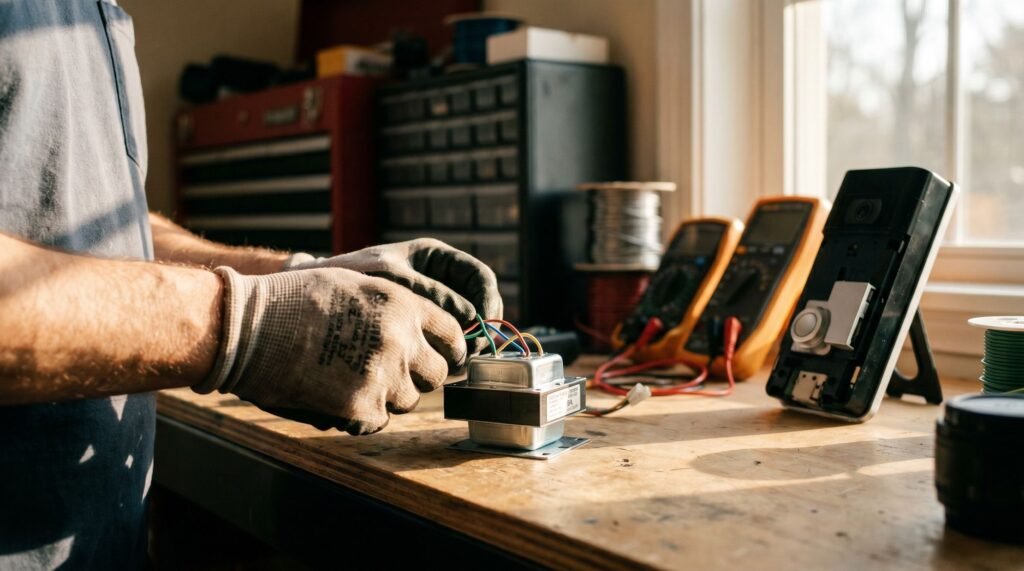
Doorbell Transformer Wiring: The Key to Reliable Smart Doorbells
The Invisible Power Gap in Modern Doorbell Wiring Your smart doorbell isn’t failing because of a bad Wi-Fi signal or a faulty device — it’s starving for power at the source. Traditional doorbells were elegantly simple. They needed nothing more than a brief electrical pulse to strike a mechanical chime, then went dormant until the next button press. The old transformer wiring designed around that logic made perfect sense for decades. But smart doorbells operate on an entirely different energy model — they’re always-on computers running continuous video streams, motion detection algorithms, and live Wi-Fi connections around the clock. That mismatch creates a predictable set of symptoms: intermittent connectivity dropouts, delayed notifications, and the frustrating phenomenon homeowners call “ghost ringing” — the doorbell triggering with no one at the door. These aren’t software bugs. They’re the hardware equivalent of running a high-performance appliance on an undersized circuit. The critical stat: standard household transformers often deliver around 10VA — less than one-third of the 30VA that modern video doorbells typically require. The industry has responded with a clear benchmark. Most video doorbell manufacturers now specify a 16V/30VA transformer as the minimum standard for stable operation. Everything else — the apps, the alerts, the HD footage — depends on getting that foundation right. Understanding this begins with examining the doorbell transformer wiring diagram, which reveals exactly where the old system ends and the new demands begin. Decoding the Doorbell Transformer Wiring Diagram A doorbell transformer is a two-sided device — and confusing those two sides is one of the most common (and dangerous) mistakes homeowners make. Understanding door chime transformer wiring involves recognizing that the transformer acts as a wall between your home’s full electrical system and the low-voltage circuit your doorbell runs on. According to ADT, standard residential transformers step down 110–120V household current to a low-voltage range of 10–24V AC — a significant drop that makes the secondary side safe to handle, but doesn’t mean the primary side is forgiving. The primary side connects directly to your home’s electrical panel. It carries three wires: ⚠️ Always shut off the breaker before touching any primary-side wiring. The 120V primary side carries enough current to cause serious injury or death. The secondary side is where the low-voltage output exits the transformer via two small terminal screws. This is where your doorbell and chime wires connect. Unlike the primary side, polarity on the secondary side is generally forgiving — most chimes and buttons will work regardless of which terminal wire goes where. Mounting location also matters more than people expect. Transformers are typically found in one of two places: mounted directly to a junction box (often near the electrical panel) or tucked inside a light-switch box. The junction box mount gives easier access and better heat dissipation — a practical advantage when upgrading to a higher-VA transformer for a smart doorbell. Once you understand this physical layout, the next logical question becomes which numbers on those terminal screws actually matter — and that’s where voltage versus volt-amps becomes the real story. The Critical Math: Voltage vs. Volt-Amps (VA) Picking the wrong transformer spec is the fastest way to destroy a perfectly good smart doorbell — and the mistake almost always comes down to confusing two related but very different numbers. Voltage (V) controls the electrical “pressure” delivered to your chime and button. More voltage than the device is rated for doesn’t give it extra power — it overwhelms it. As 1800doorbell notes, using a 24V transformer on a 16V-rated chime can cause immediate damage. This is especially relevant when learning how to wire a doorbell transformer, because grabbing the wrong unit from the hardware shelf is an easy mistake to make. Volt-Amps (VA), on the other hand, represent the system’s total capacity — think of it as the size of the pipe, not the pressure inside it. A higher VA rating is generally safe because your doorbell draws only the power it actually needs. Where voltage mismatch causes damage, a VA mismatch typically causes brownouts and resets. Most traditional chimes run fine on 10VA, but smart doorbells commonly require 20–40VA to power Wi-Fi radios, cameras, and internal charging circuits. Pro Tip: When in doubt on VA, size up — not down. A 40VA transformer powering a device that needs only 20VA causes no harm whatsoever. A Tri-Volt transformer offers an elegant solution when your household has mixed hardware — perhaps an older mechanical chime alongside a new video doorbell. These units support multiple voltage outputs (typically 8V, 16V, and 24V) from a single device, eliminating the guesswork entirely. Once you understand these two specs clearly, the physical installation becomes much more straightforward — which is exactly what we’ll tackle next. Step-by-Step: Installing a Hardwired Transformer Kit Replacing a doorbell transformer is one of the more approachable electrical tasks a homeowner can take on — but only when done in the right sequence. Before you touch a single wire, pull up your doorbell transformer wiring diagram so you’re clear on which terminals handle high-voltage house power and which handle low-voltage bell wiring. That single reference prevents the most costly mistakes. ⚠️ Safety Warning: Always verify power is off with a non-contact voltage tester before handling any wiring. Never assume flipping the breaker is enough — confirm it. Here’s the correct installation order: Once the box is closed and power restored, even a correctly installed transformer can underperform if your wiring runs are unusually long — which is exactly where the next complication tends to surface. Solving the ‘Voltage Drop’ in Long Wiring Runs Voltage drop is one of the most overlooked reasons a hardwired transformer setup fails — even when the transformer itself is perfectly spec’d. The core problem: electrical resistance accumulates over distance. Every foot of wire between your transformer and doorbell introduces resistance, and that resistance bleeds off voltage before it ever reaches the device. A transformer outputting a clean 16V at the panel might deliver only 12V or 13V by
Doorbell Transformer Wiring: The Key to Reliable Smart Doorbells Read Post »