
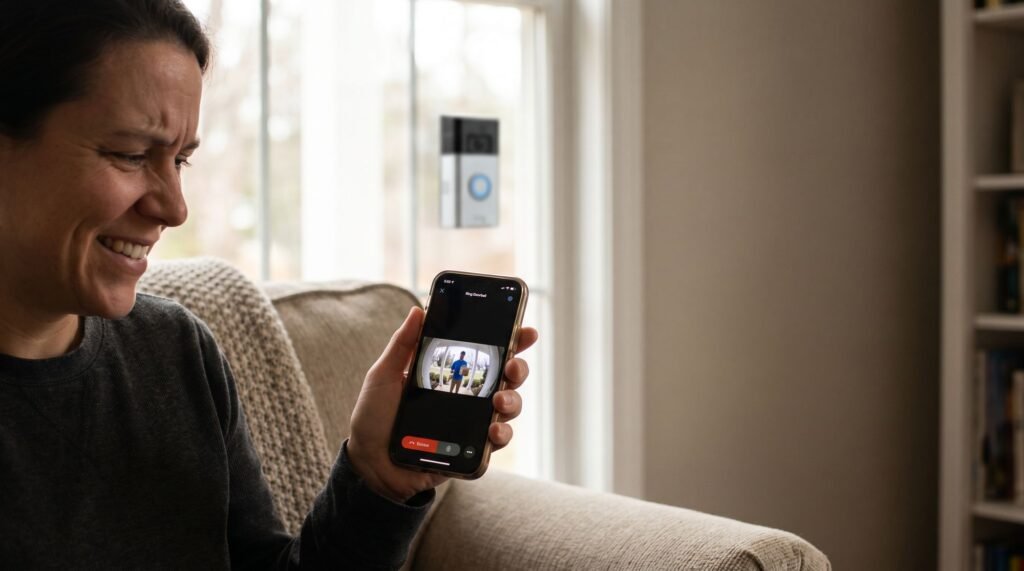
How Ring Doorbells Work: The Technology Behind the Chime
Beyond the Button: The Three Pillars of Ring Technology Understanding how Ring doorbells work reveals a sophisticated system beyond a simple wireless doorbell. These devices function as Wi-Fi-connected camera and intercom systems, acting as a full-time digital gatekeeper for the modern home. At its core, understanding how a Ring Video Doorbell works involves three distinct pillars that operate in sequence: What makes Ring more than a camera is the cloud. As Ring.com confirms, Ring devices combine camera optics with cloud-based processing to deliver real-time video streaming and Live View features. The intelligence isn’t just in the hardware sitting on your doorstep. The Ring app serves as the central control panel for everything. From adjusting motion sensitivity to reviewing recorded clips or speaking with a visitor through two-way audio, nothing happens without it. For anyone researching how Ring doorbells work, app dependency is a critical part of the answer — the device and software are inseparable. Each of those three pillars involves its own layer of technology, and the first place to start is at the very moment the system wakes up: detection. That process relies on some genuinely fascinating physics. The Physics of Detection: How PIR Sensors See the World Ring doorbells don’t actually “see” motion the way a human eye does — they sense heat, and that distinction changes everything about how the technology performs. Passive Infrared (PIR) sensors work by detecting changes in infrared radiation emitted by warm bodies — people, animals, and vehicles all radiate heat signatures that differ from their surroundings. Rather than analyzing pixel-by-pixel video changes, PIR sensors identify shifts in heat signatures to filter out irrelevant movement like swaying tree branches or passing shadows. This approach significantly reduces false alerts, which matters when you’re relying on notifications throughout the day. Understanding how Ring video doorbells work means understanding the Fresnel lens — the dome-shaped component sitting in front of the PIR sensor. Its diamond-like facets divide the sensor’s field of view into distinct zones. As a warm body crosses from one zone to the next, the sensor registers a heat spike. This zoning system is why motion moving across the camera’s field triggers detection far more reliably than someone walking directly toward it — a person approaching head-on moves through fewer zone boundaries, generating a weaker signal transition. 📍 Stat to know: Ring doorbells typically detect motion within a horizontal range of 5 to 30 feet, covering a 90 to 120-degree arc, according to Toggle Academy. In practice, this arc captures most standard front-porch activity effectively. However, the vertical detection range is narrower by design — the sensor is optimized for ground-level movement rather than overhead activity. Knowing these boundaries helps set realistic expectations before you ever adjust a sensitivity setting. All of this detection capability depends on one critical variable: consistent power. That’s where the choice between battery and hardwired installation becomes far more consequential than most buyers anticipate. Powering the Chime: Battery vs. Hardwired Mechanics Power delivery is a key factor in understanding how a Ring doorbell works — shaping everything from installation ease to long-term reliability. Battery-powered models win on convenience; hardwired models win on consistency. Battery units require no existing wiring, making them ideal for renters or older homes. Hardwired versions tap into your existing doorbell wiring (typically 8–24V AC) and use a trickle-charge mechanism to keep the internal battery topped up continuously — meaning the device stays live without ever needing a manual recharge. Battery longevity under “standard usage” — roughly 3–5 motion events per day with occasional Live View checks — lands between 6 and 12 months per charge. However, real-world conditions frequently compress that window. According to HelloOval, high-traffic areas can slash battery life down to just 1–3 months. Several factors accelerate that drain: Understanding these drain factors matters beyond just convenience — a depleted battery means gaps in coverage, missed alerts, and a front door that’s temporarily blind. That visibility gap connects directly to another layer of the system: what happens to the footage once it’s captured, and whether it’s saved at all. The Cloud Connection: Why Subscriptions Matter Understanding how Ring cameras work at a deeper level involves confronting one of the most debated topics in smart home communities: the subscription model. A Ring doorbell functions without a paid plan — but your ability to review what it captured does not. The core device handles live alerts, real-time video through the app’s Live View feature, and the doorbell chime itself entirely for free. Where the paywall appears is video storage. Without a Ring Protect plan, motion-triggered clips are never saved to the cloud — they play out in real time and disappear. As confirmed by Ring’s own community documentation, users without a subscription can receive alerts and access Live View, but cannot review, save, or share any recorded footage. This nuance matters when evaluating the “useless without a subscription” sentiment that surfaces regularly in user forums. That framing overstates the limitation. A subscription-free Ring doorbell still notifies you the moment someone approaches, lets you speak with visitors remotely via two-way audio, and rings like any traditional doorbell. What it cannot do is serve as a forensic record — there’s no footage to pull if a package goes missing or an incident occurs overnight. “I didn’t realize until after install that I’d need a plan to actually watch anything after the fact. Live alerts are great, but without recordings, it’s basically a fancy intercom.” — community feedback via Reddit For many households, the free tier covers everyday needs — particularly if the goal is real-time awareness rather than archival security. That said, the practical value of a connected, intelligent device scales significantly once recorded history is available. That question of how you use your footage — and where you point the camera to capture it — leads directly into an equally important consideration: responsible placement and privacy. Ethical Surveillance: Privacy and Placement Owning a smart doorbell comes with real responsibilities — where you point the
How Ring Doorbells Work: The Technology Behind the Chime Read Post »