
Smart Home Installation: Why Professional Beats DIY
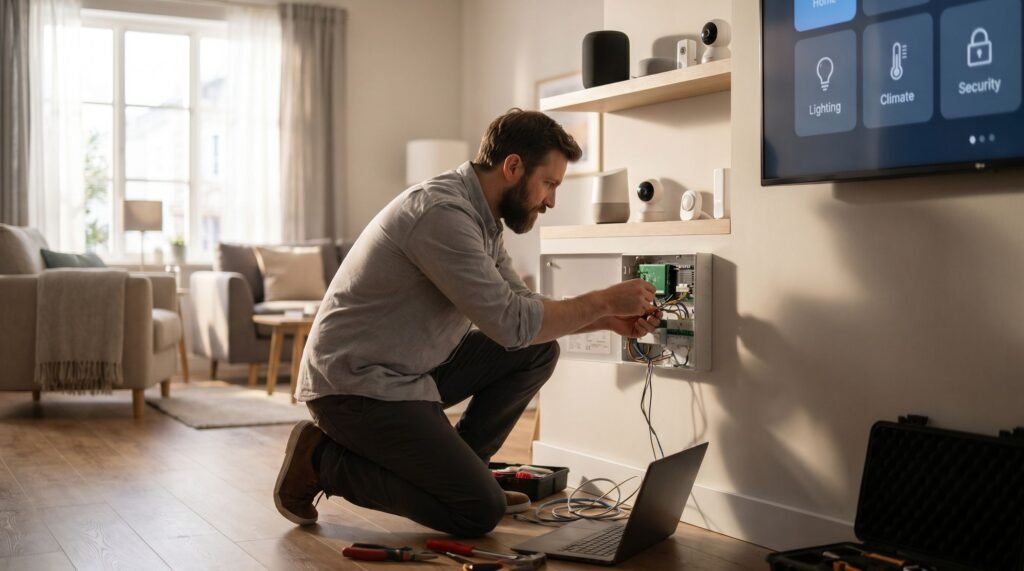
The Evolution of Automated Smart Homes: Beyond the Plug-and-Play Era The modern automated smart home of 2026: a fully integrated ecosystem where lighting, climate, shading, and security work as one unified system. The smart home of 2026 vastly differs from the initial plug-in gadget collections many homeowners began with—and this discrepancy is more costly than one might think. A decade ago, installing a smart bulb or a Wi-Fi thermostat seemed progressive. It was. But what started as a convenient experiment has evolved into a demanding endeavor. Homeowners today aren't merely managing a single device—they're orchestrating interconnected ecosystems for lighting, climate control, smart home security, locks, cameras, entertainment, and energy management, all from a mishmash of competing apps. The 'app for everything' model has broken down under its own weight. This fragmentation is where the modern DIY smart home falters. In reality, the average connected household uses between eight and fifteen apps from different manufacturers, each with its own update cycle, login, and failure point. What was marketed as convenience has become a part-time job. Homeowners frequently troubleshoot routines that stopped working, re-pair devices after firmware updates, and manually override conflicting automations. The promise of a seamless lifestyle has become a web of conditionals and workarounds. A true smart home installation differs fundamentally from a simple device setup. Device setup means adding hardware. A professional installation involves designing an integrated architecture—where every subsystem communicates on a unified platform, automations trigger reliably without human intervention, and infrastructure is built to scale. This includes hardwired backbone networks, centralized control processors, and scenes responding to a family's lifestyle, not just voice commands in a quiet room. This distinction matters as it redefines what smart home investment truly means. As John Smith of Enroot Home puts it, "Smart systems not only protect homes but also enhance the quality of life through lifestyle return on investment (ROI)." This concept of lifestyle ROI shifts the conversation from gadget costs to long-term value: energy savings, security confidence, resale appeal, and reduced daily friction. Understanding why professional involvement strengthens ROI starts by examining market trends and why the complexity of modern ecosystems makes professional-grade integration a practical necessity. Why Professional Smart Home Services Dominate the Market Professional integrators lead home automation installations because modern systems have outgrown what Wi-Fi dongles and app-based setups can reliably deliver. The evolution from simple gadgets to full ecosystems is the core driver. A contemporary smart home does more than run a few connected bulbs—it coordinates climate control, security cameras, door locks, entertainment systems, and energy management across dozens of devices. This coordination demands hardwired infrastructure: dedicated low-voltage wiring, structured cabling, and centralized control architecture. Without it, an intelligent setup becomes a fragile network of conditional automations that fail when a router drops or a firmware update occurs overnight. Professional integrators build hardwired backbones—structured cabling and centralized control panels that keep automations running without cloud dependency. The reliability gap between consumer Wi-Fi products and professional control systems is significant. DIY setups rely on cloud servers, mesh networks, and app ecosystems that can—and do—go offline. Professional-grade installations use hardwired protocols and local processing, ensuring the system functions regardless of internet connectivity. Lighting scenes activate on time, security panels remain armed, and climate schedules run uninterrupted. This dependability isn't a luxury; for households deeply integrated with automation, it differentiates a working system from a frustrating one. Market data reflects this dynamic. According to an industry report by Mordor Intelligence, professional smart home installation services accounted for 70.54% of total market revenue in 2025—indicating that homeowners aren't choosing professional services due to a lack of DIY options. They're choosing them because the complexity of whole-home integration exceeds what self-installation can sustain long-term. Three technical advantages highlight why professional wiring consistently outperforms wireless setups: Dedicated low-voltage runs eliminate signal interference between high-traffic devices. Centralized control panels provide local processing that keeps automations running without cloud dependency. Structured cable pathways allow system expansion without retrofitting walls later. This last point is crucial. A professionally installed backbone scales efficiently as new devices join the ecosystem—and as the next section explores, these upfront infrastructure investments have substantial financial implications. The Financial Reality: Smart Home Installation Cost and ROI Automated smart homes offer measurable financial returns—but only when you understand the complete cost upfront, not after accumulating receipts. The entry point: Basic smart home setups—such as connected lights, a smart lock, and a thermostat—typically cost between $200 and $500 for hardware alone. Whole-home automation, however, is a different conversation. According to HomeAdvisor's 2026 home automation cost guide, professionally integrated systems for a full residence range from $10,000 to over $150,000, depending on scope, device complexity, and labor. This range seems broad until you consider the returns each tier provides. Insurance savings are real and underused. A major overlooked financial benefit lies in homeowners insurance policies. Smart home security systems—monitored cameras, smart door locks, leak sensors—can reduce annual premiums by 5% to 15%, according to the Insurance Information Institute. For a $2,000/year policy, that's up to $300 saved annually. Over a decade, this savings can offset a significant portion of the original installation cost. A smart thermostat alone delivers 8%–10% savings on annual heating and cooling bills—one of the fastest ROI wins in home automation. Energy efficiency compounds savings. A smart thermostat alone provides an average of 8% to 10% savings on annual heating and cooling bills, as noted in Rently's energy analysis. For a household spending $2,400/year on climate control, that's $192 to $240 saved annually—without changing behavior. Add smart lighting schedules, occupancy sensors, and appliance automation, and savings increase substantially. The hidden DIY cost is measured in hours and hardware. DIY budgets often overlook ongoing maintenance burdens—troubleshooting integrations after firmware updates, replacing incompatible devices, and relearning systems when something breaks. This friction has a real dollar value. Property value is a significant long-term multiplier. Homes with professionally integrated automation consistently attract more buyer interest, influencing which system tier aligns with your goals—a topic the next section addresses directly. DIY vs.
Smart Home Installation: Why Professional Beats DIY Read Post »