
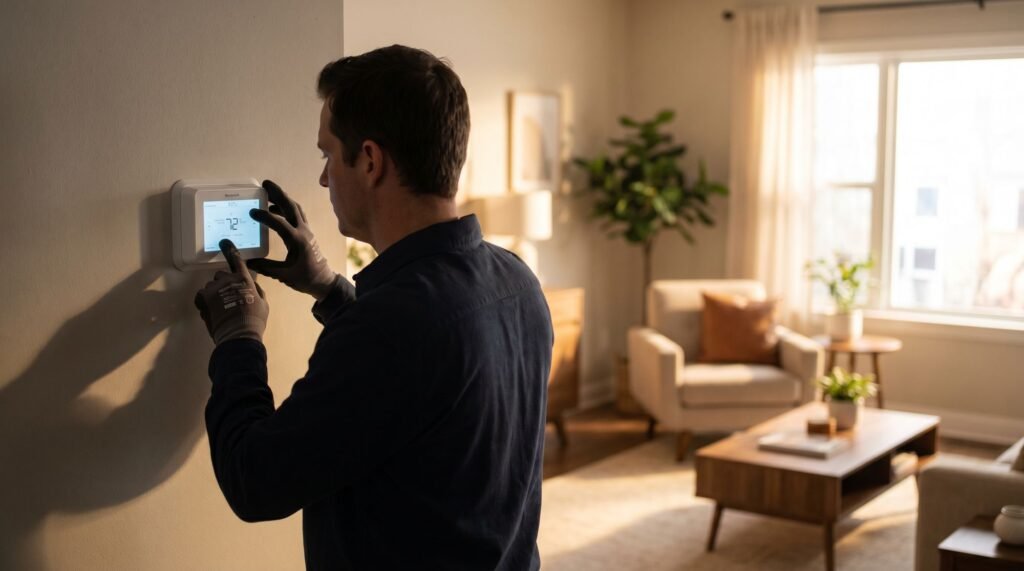
Honeywell T10 Pro Review: Why HVAC Pros Still Recommend It
The Honeywell T10 Pro: Professional Grade in a Consumer World There is nothing more frustrating than a ‘smart’ thermostat that isn’t actually smart enough to handle your home’s layout. I’ve seen it dozens of times: a homeowner spends $250 on a flashy retail model, only to find themselves waking up in a sweat because the hallway is cool but the bedroom is a furnace. Most consumer-grade units prioritize a pretty interface over the actual physics of HVAC, leaving you with dropped Wi-Fi signals and a system that can’t quite decide when to engage the second stage of your heat pump. After years of testing and troubleshooting residential climate systems, I’ve found that the pros consistently gravitate toward one specific workhorse: the Honeywell T10 Pro. While the rest of the world chases touchscreens and voice-assistant gimmicks, the T10 focuses on the foundational reliability of RedLINK 3.0. It’s the device I recommend when a client is tired of ‘smart’ glitches and just wants a system that maintains a perfect 72 degrees across every square inch of their house, regardless of where the thermostat is actually mounted. The Honeywell T10 thermostat isn’t built for the big-box store shelf — it’s engineered for HVAC professionals who need reliability over flash, and that distinction matters more than most homeowners realize. At the center of the T10 lineup sits model THX321WFS2001W, a device designed from the ground up for contractor installation rather than DIY unboxing. While the T9 targets retail buyers looking for a smart thermostat with room sensors, the T10 Pro is a professional-channel product with tighter integration requirements, deeper compatibility with multi-stage and heat pump systems, and a more deliberate setup workflow. That isn’t a drawback — it’s the point. The real differentiator is RedLINK 3.0, Honeywell’s proprietary wireless protocol that powers the sensor ecosystem. Unlike generic Wi-Fi or Zigbee-based alternatives, RedLINK 3.0 is purpose-built for HVAC environments where interference, distance, and wall penetration create real-world reliability challenges. The T10 Pro supports up to 20 individual RedLINK wireless room sensors with a range of 200 feet. HVAC professionals prefer this dedicated RF network because it removes the thermostat from the ‘IT troubleshooting’ bucket—ensuring the system functions perfectly even if the homeowner changes their Wi-Fi password or the router fails. — a spec that makes the unit genuinely scalable for larger homes. One point of confusion worth noting upfront: the Honeywell Home brand is owned and operated by Resideo Technologies, following a 2018 spin-off. The Honeywell name on the thermostat is a licensed trademark. When comparing the Honeywell T10 vs ecobee or any competing platform, understanding that Resideo — not Honeywell — handles product development and support is essential context. More on the model lineup’s current status is coming up next. Is the Honeywell T10 Discontinued? Clearing the Confusion If you’ve searched “is the Honeywell T10 discontinued,” you’re not alone — but the short answer is no, the T10 series is very much alive. The confusion stems from specific SKUs quietly cycling out of retail distribution, which triggers “discontinued” flags on third-party listing sites. What’s actually happening is a product evolution, not a product death. The T10 line transitioned to the T10+ (model THX321WFS3003W), which is the current professional-grade offering. The core technology carries over — RedLINK 3.0 sensors, multi-room averaging, and contractor-grade reliability all remain intact. The T10+ adds meaningful refinements that matter in real-world installs. The most notable addition is the Fallback Room setting, exclusive to the T10+. If a remote sensor loses communication, the thermostat automatically falls back to a designated “anchor” room rather than defaulting to the potentially biased reading from a utility closet or equipment room. According to Honeywell Home, this prevents skewed temperature control — a real problem that base-model units can’t solve. One practical caution: watch for “New Old Stock” units on discount sites. These are original T10 boxes that retailers are clearing out. They’ll install and function fine, but you’ll miss the Fallback Room feature and may face firmware limitations down the road. For new installs, sourcing the T10+ directly through an HVAC distributor is the safer call. That hardware reliability is only part of the story. What really separates the T10 series from standard smart thermostats is how it communicates across your home — and that’s where RedLINK 3.0 changes everything. Why RedLINK 3.0 Beats Standard Wi-Fi for Whole-Home Comfort The T10’s real intelligence isn’t in its Wi-Fi connection — it’s in RedLINK 3.0, the proprietary wireless protocol that ties the entire sensing network together. Wi-Fi handles one job: keeping the Resideo app connected to your phone. RedLINK 3.0 handles everything that actually affects comfort — communicating with remote room sensors up to 200 feet away, far beyond what standard Bluetooth-based smart sensors can manage in a typical home. RedLINK range advantage is where this distinction becomes practical. Bluetooth sensors commonly cap out around 30 feet with walls in the way. RedLINK 3.0 cuts through building materials reliably, making it viable for multi-story homes, finished basements, or sprawling ranch layouts where a single thermostat reading is essentially useless. The Honeywell Home THX321WFS2001W T10 Pro thermostat uses that extended range to do something genuinely useful: average temperature and humidity readings across every room where a sensor is placed, weighted by occupancy. Motion data tells the system which rooms are actually in use, so you’re not conditioning an empty guest room at the expense of the living room where everyone actually is. According to Resideo, this kind of consistent scheduling and smart sensing can save users an average of 22% on heating costs and 17% on cooling costs annually. Each T10-compatible room sensor contributes: That combination of occupancy awareness, humidity sensing, and extended range is what separates the T10 from simpler smart thermostats — and it sets up a meaningful comparison when you look at how competing platforms handle humidity control across the whole home. Honeywell T10 vs. Ecobee: The Humidity Control Factor When it comes to whole-home humidity management, the T10 holds a clear technical advantage
Honeywell T10 Pro Review: Why HVAC Pros Still Recommend It Read Post »