
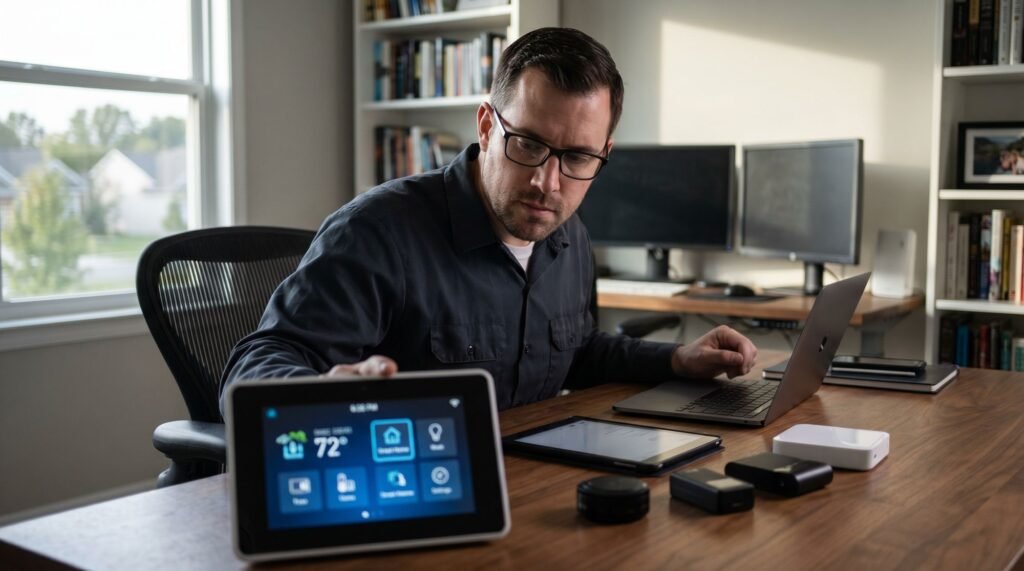
Why Your Smart Home Needs a Z-Wave Hub
The Congestion Crisis: Why Your Wi-Fi Isn't Enough I’ve spent years chasing the "perfect" smart home setup, and for a long time, it felt like a losing battle. There is nothing more frustrating than standing in a dark room, shouting at a voice assistant for the third time, only to have the lights flicker on five seconds after you’ve already given up. I used to think it was a hardware brand issue—that I just needed "better" Wi-Fi bulbs or a faster router—but after auditing dozens of setups, I realized the problem wasn't the devices. It was the foundation. The truth is, most homeowners set themselves up for failure by relying on a congested Wi-Fi network to handle dozens of tiny, low-bandwidth commands. After switching my own home to a dedicated Z-Wave ecosystem, the "ghosting" and lag disappeared overnight. Finding the right z-wave controller was the turning point for me. In this guide, I’m sharing why a dedicated z-wave smart home hub is the single most important investment you can make for a stable network and why it's the missing piece for anyone tired of "No Response" errors. Dropped commands, delayed responses, and lights that ignore you — these aren't bugs in your smart devices, they're symptoms of a congested wireless environment fighting for the same airwaves. The 2.4 GHz band is one of the most overcrowded spaces in modern homes. Your Wi-Fi router, Bluetooth speaker, microwave, baby monitor, and every neighbor's network are all competing in that same narrow slice of spectrum. When your smart switch sends a command, it's essentially shouting in a crowded room — sometimes the message gets through, sometimes it doesn't. This is exactly the problem a Z-Wave controller solves. Rather than routing every device command through your already-burdened Wi-Fi router, a dedicated Z-Wave hub acts as a specialized traffic controller — a separate system built exclusively to manage smart home device communication. It keeps automation signals off your main network entirely, eliminating the interference that causes unreliable performance. The secret is frequency. According to the Z-Wave Alliance, Z-Wave operates on a dedicated sub-GHz frequency of 908.42 MHz in the US — a virtually private lane for your smart home data. At that frequency, Z-Wave signals don't compete with Wi-Fi or Bluetooth traffic at all. The result is a cleaner, more reliable signal path for every device in your home. Understanding why that dedicated frequency works so well, though, comes down to how Z-Wave devices talk to each other — and that architecture is more clever than you might expect. How a Z-Wave Mesh Network Actually Works A Z-Wave mesh network is fundamentally different from Wi-Fi — and that difference is exactly why a Z-Wave smart home hub can deliver the reliability a congested router simply can't. Wi-Fi uses a star topology: every device connects directly back to your router. If a device is too far away, or if too many devices compete for bandwidth simultaneously, the signal degrades. There's no fallback, no alternative path — just a weakening connection. Z-Wave solves this with a mesh topology. According to Silicon Labs, a single Z-Wave network supports up to 232 connected devices, and every mains-powered device on that network also functions as a signal repeater. That means your network grows stronger as it grows larger. Here's how a signal hop actually works: Command originates — The hub sends a signal to a device across the house. Hop in progress — Instead of reaching directly, the signal bounces through intermediate mains-powered devices (a smart plug, a light switch) along the most efficient route. Delivery confirmed — The target device receives the command and sends an acknowledgment back through the same mesh. The more mains-powered devices you add, the more robust and self-healing your network becomes. Battery-powered sensors — door contacts, motion detectors — receive signals but don't repeat them, keeping their power consumption low while still benefiting from the mesh. This architecture has real implications for how your devices are certified and whether they can communicate across different brands — which is where the story gets even more interesting. The Interoperability Mandate: Why Certification Matters Every smart home hub Z-Wave buyer eventually asks the same question: what stops devices from different brands from clashing? The answer is a mandatory certification process that competitors simply don't enforce. "Z-Wave's interoperability is its strongest suit; every Z-Wave device must pass a stringent certification process to ensure it works with every Z-Wave certified hub." — Mitchell Klein, Z-Wave Alliance That word "every" is doing significant work. It isn't a marketing promise — it's a technical requirement baked into the standard itself. Before any manufacturer can ship a Z-Wave product, it must pass independent testing that verifies cross-brand compatibility. The result is a catalog of thousands of certified devices — locks, sensors, dimmers, thermostats — that all speak a guaranteed common language. In practice, this eliminates the silo effect that frustrates users of other ecosystems. With competing smart home platforms, "compatible" often means "works under ideal conditions, with this app, on this firmware version." Z-Wave certification means something closer to unconditional interoperability. As How-To Geek notes, a hub becomes the critical translator layer — bridging hardware from entirely different manufacturers into a single, unified system. That translation role is where the hub earns its place. Without it, you're managing brand-specific apps in parallel. With it, a certified lock from one manufacturer responds seamlessly to a certified motion sensor from another. The certification mandate makes that possible — and as Z-Wave hardware continues to evolve, the next generation of that standard raises the ceiling even further. The 800 Series Revolution and Long-Range Connectivity The Z-Wave 800 Series is the clearest hardware upgrade the protocol has seen in years — and it changes what a smart home can realistically cover. The headline number is hard to ignore: according to Silicon Labs and the Z-Wave Alliance, the 800 Series delivers a wireless range exceeding 1.5 miles (2,400 meters) in open air. Inside a typical home,
Why Your Smart Home Needs a Z-Wave Hub Read Post »