
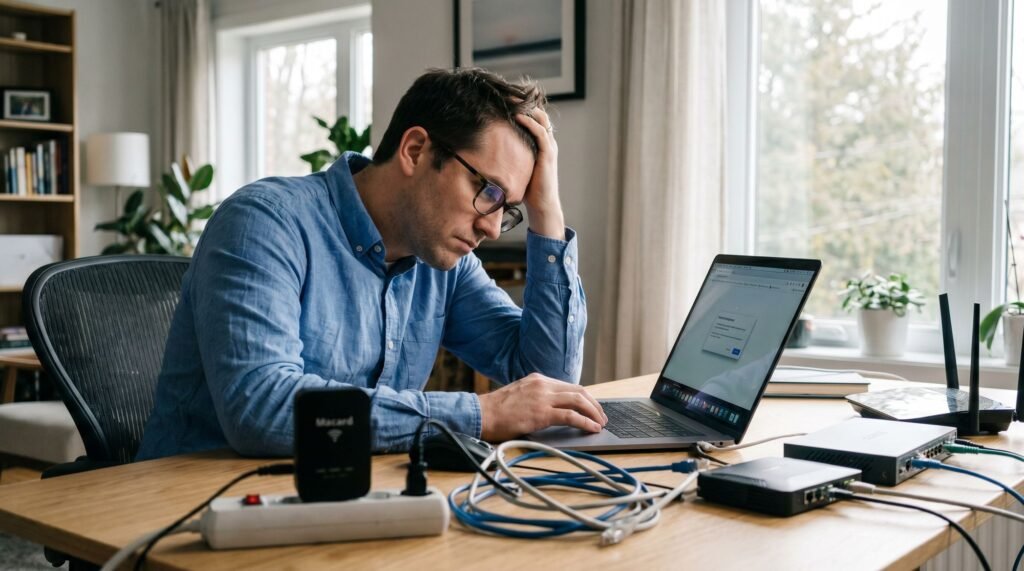
Macard WiFi Extender Setup: Fix Problems Fast
The Reality of Macard WiFi Extender Setup There is nothing more frustrating than unboxing a Macard WiFi extender, expecting an instant "dead zone" fix, only to be met with a blinking amber light and a "No Internet" message on your phone. I’ve spent countless hours troubleshooting home networks, and I know the feeling: you just want to finish your favorite show or join a video call without the dreaded buffering wheel. The Macard N300 and RE1200 series are capable devices, but their "quick start" guides often skip the real-world hurdles like browser timeouts and IP conflicts that leave most users stuck before they even begin. In my experience setting up hundreds of range extenders for clients and my own home office, the solution isn't usually a hardware defect—it's a configuration mismatch. Whether you're struggling with the 192.168.10.1 portal or your router's WPS button is being stubborn, I’ve documented the exact sequence that actually works. This guide cuts through the technical jargon to give you the exact steps I use to get these units stable in under five minutes, so you can stop staring at the router and start enjoying your full bandwidth. Dead zones are no longer a minor inconvenience — they're a genuine problem for households running dozens of connected devices simultaneously. The global Wi-Fi extender market is projected to hit $3.8 billion by 2024, fueled by a 17.17% surge in smart home device adoption the previous year. Every new smart TV, security camera, and voice assistant added to your network puts more pressure on your router's range — and that's exactly where a range extender earns its place. Macard is a popular choice, but Macard WiFi extender setup isn't always the seamless experience the packaging suggests. The device ships with three distinct setup paths: WPS button pairing, a wired Ethernet connection, and a manual web-based configuration through a browser. Each method has its place, but they aren't equally reliable in real-world conditions. WPS is the fastest option on paper — press a button, wait, done. Ethernet offers a stable, direct connection for those comfortable with cables. The manual web-based method, however, gives you the most control over signal channels, network names, and password settings. In practice, that extra control is often what separates a stable connection from a frustrating loop of failed attempts. Before diving into why each approach succeeds or stumbles, it's worth understanding where the WPS method — despite its convenience — tends to break down most often. Why the WPS Method Often Falls Short The WPS button looks like the easiest path through a WiFi repeater setup — but that simplicity is mostly an illusion. WPS pairs devices automatically only when every condition is met perfectly, and most home environments make that surprisingly difficult. Here's what has to go right for WPS to work: The router and extender must be close enough during initial sync — ideally within 3–5 feet — even though you'll eventually place the extender much farther away You must press both the router's WPS button and the extender's button and complete the handshake within a strict two-minute window, per Gadget Rumours The extender's physical ON/OFF switch must be in the ON position — a detail many users overlook entirely after unboxing Your router must actually support WPS — older firmware or security-conscious configurations often have it disabled by default ⚠ Speed Warning: Even a successful WPS connection won't protect you from the half-duplex limitation every extender carries. Because the device must receive and retransmit on the same channel, TerraListens notes that speeds typically drop by 50% — a 50 Mbps signal effectively becomes 25 Mbps on the extended network. That's a hardware reality, not a setup error. When WPS fails, it rarely fails loudly. The extender may appear connected while delivering no usable signal, leaving you troubleshooting the wrong problem. That's exactly why the manual setup route — using a direct IP address and browser-based configuration — gives you far more control and visibility into what's actually happening. Mastering the 192.168.10.1 Manual Setup The browser-based setup method is the most reliable way to complete a Macard wifi extender configuration — and once you understand the sequence, it takes under five minutes. Before you can learn how to set up WiFi extender devices the right way, you need to connect to the right network. After plugging in the extender and waiting for its indicator light to stabilize, open your device's WiFi settings and connect to the broadcast signal labeled "Macard_Extender" or "Wi-Fi Extender." This is the temporary setup network the device broadcasts before it's configured — don't skip this step. With that connection active, open any browser and navigate to 192.168.10.1 or go.macard.online to reach the setup interface. Either address loads the same configuration panel. Pro Tip: If 192.168.10.1 doesn't load, confirm you're still connected to the Macard_Extender network — your device may have auto-reconnected to your home WiFi. From there, the steps are straightforward: Enter credentials — type admin in both the username and password fields. Select your host network — the interface scans and lists nearby networks; choose yours. Enter your WiFi password — type it carefully, as incorrect passwords are the single most common setup failure point. Apply and wait — the extender reboots and connects. Of course, completing setup correctly is only half the battle. Where you physically place the extender determines whether you actually eliminate those dead zones — and that's where most people make their second critical mistake. Optimal Placement for Your Signal Booster Where you physically place your extender matters just as much as how you configure it — and poor placement can undermine even a flawless Macard WiFi extender setup 192.168.10.1 configuration. The single most important placement principle is the "Halfway Rule": position the extender midway between your router and the dead zone, not inside the dead zone itself. In practice, an extender needs a strong incoming signal before it can rebroadcast anything useful. Placing it too far from the router starves it
Macard WiFi Extender Setup: Fix Problems Fast Read Post »