
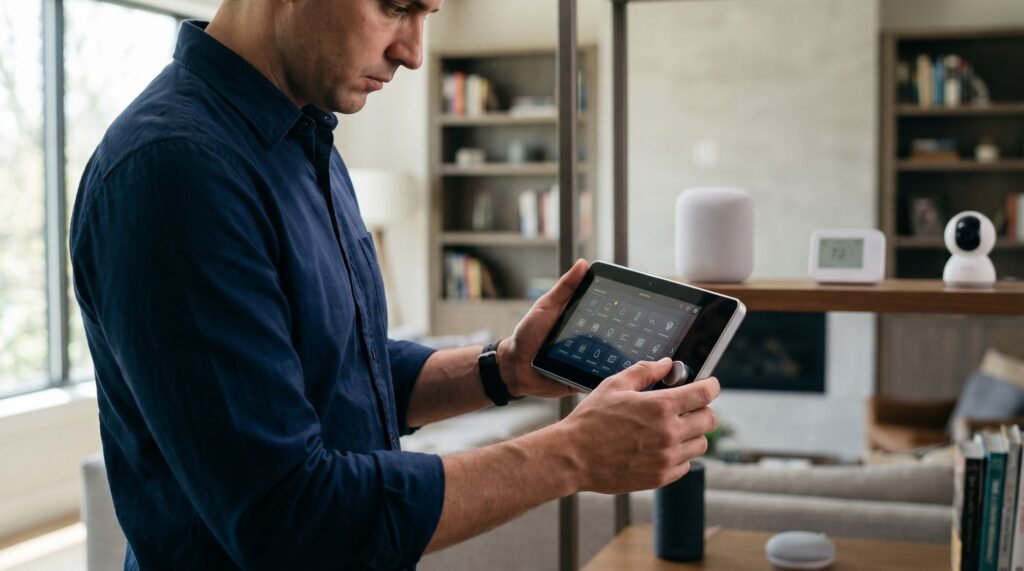
Why a Smart Home Hub Is Essential for Modern Homes
The Fragmentation Problem: Why Apps Aren't Enough Managing a smart home shouldn't feel like juggling 15 different businesses, but for many households, that's the reality. Imagine this: you want to dim the lights using your phone, but you open the wrong app, then switch to another to adjust the thermostat, and yet another to check if the front door is locked. Welcome to the world of modern smart homes, where app fatigue takes center stage. The convenience that was promised has become a source of frustration due to fragmentation. As soon as a home starts collecting connected devices, the challenges become apparent: Managing five or more manufacturer apps for a single room Automations failing whenever a cloud server is down Devices from different brands refusing to communicate Slow response times due to distant data centers No unified dashboard to display the entire home status Wi-Fi alone exacerbates the issue rather than solving it. Every Wi-Fi device competes for bandwidth on the same network. As the number of devices increases, routers struggle, and reliability drops—a bottleneck no firmware update can fully fix. Cloud-based apps add another layer of risk. When a manufacturer's server fails or a company shuts down, devices can become useless overnight. A local hardware controller processes commands within the home, removing the need for cloud interaction and ensuring functionality even when the internet is down. This is where a smart home hub steps in to transform the scenario. As CNET notes, "the centralization is really the prize here… a smart hub can integrate different networks, uniting Wi-Fi, Zigbee, Z-Wave, and Bluetooth in one easy-to-manage app." Understanding how a hub achieves this and its capabilities beyond app consolidation is where the real story unfolds. What Does a Smart Hub Actually Do? A smart home hub does much more than serve as a remote control—it acts as the central nervous system that translates, processes, and orchestrates every device in your home. As discussed earlier, fragmentation arises from devices using completely different languages. Protocol translation is where a hub first proves its worth. Zigbee, Z-Wave, Bluetooth, and Wi-Fi each operate on different frequencies and communication standards. Without a hub, a Zigbee-based smart bulb and a Z-Wave door sensor cannot interact—they remain strangers. According to My Smart Home Authority, smart home hubs also function as a Matter bridge, making legacy Zigbee and Z-Wave devices compatible with modern ecosystems, ensuring older hardware remains valuable. Local processing is a critical function that many overlook until the internet goes down. Cloud-dependent devices route every command through a remote server before anything happens in your home. A hub with local processing keeps automation logic running on your network, enabling your lights to respond in milliseconds and your routines to continue during outages. As Aqara explains, local control also reduces latency and protects your data from unnecessary exposure. Complex, cross-brand automation is where the real magic happens. A hub can monitor your video doorbell, and when it detects a visitor, it can trigger smart bulbs from a different ecosystem to flash—no shared app needed. This kind of conditional logic is impossible when devices operate in isolation. A hub doesn't just connect devices—it enables them to collaborate intelligently, regardless of their manufacturer. Finally, hubs manage device management at scale: pushing firmware updates, monitoring device health, and keeping your entire ecosystem running smoothly without requiring manual intervention on each product. All of this sets the stage for an even bigger industry shift—one that could determine whether your current hardware survives the next wave of smart home standards. The Matter Revolution and Future-Proofing Your Home The smartest investment you can make in your smart home today is choosing a smart home hub built around open, universal standards—because the protocol landscape is evolving rapidly. Matter is the new industry-standard connectivity protocol supported by Apple, Google, Amazon, and hundreds of manufacturers. Its companion technology, Thread, provides a low-power, mesh-based radio network that allows devices to communicate directly with each other—no cloud dependency required. Together, they promise what the smart home industry has long pursued: genuine interoperability out of the box. However, the transition won't happen overnight. Many households own devices running Zigbee, Z-Wave, or Wi-Fi protocols that predate Matter. A capable hub bridges that gap, acting as a translator that keeps legacy hardware functional alongside newer Matter-certified gear. Without that bridge, older devices become obsolete as soon as you upgrade your ecosystem. Feature Legacy Devices (Pre-Matter) Modern Matter-Certified Devices Protocol Zigbee, Z-Wave, proprietary Matter over Thread or Wi-Fi Hub Required? Yes — essential Optional, but still recommended Cloud Dependency Often required Minimal — local processing supported Cross-Platform Support Limited Native across major platforms Longevity Risk Higher without a bridging hub Lower, but evolving Buying a hub today is effectively buying hardware insurance for tomorrow. As the global smart home market approaches a projected $157.91 billion by 2026, device proliferation will only accelerate—leading to more protocols, more manufacturers, and more potential for fragmentation. A hub sits at the center of it all, absorbing change rather than forcing you to replace perfectly functional devices. That future-proofing capability extends beyond protocol support alone—and it connects directly to one of the most tangible benefits hub owners report: meaningful reductions in household energy costs. Energy Efficiency: The Hidden ROI of Centralization A dedicated smart home hub provides measurable financial returns—not just convenience—by turning your home into an intelligent energy management system. According to research cited by ACEEE via PointCentral, integrated Home Energy Management Systems (HEMS) can reduce household energy consumption by 5% to 22%. That's a significant decrease in monthly utility bills, made possible because a centralized hub can coordinate devices in ways isolated, app-controlled gadgets cannot. HEMS efficiency relies on the hub's ability to aggregate data across your entire home and act on it instantly. When your thermostat, smart lighting, motorized blinds, and occupancy sensors all report to a single hub, the system can identify waste patterns that no single device would catch alone. A room that's been empty for 20 minutes can trigger automated
Why a Smart Home Hub Is Essential for Modern Homes Read Post »