
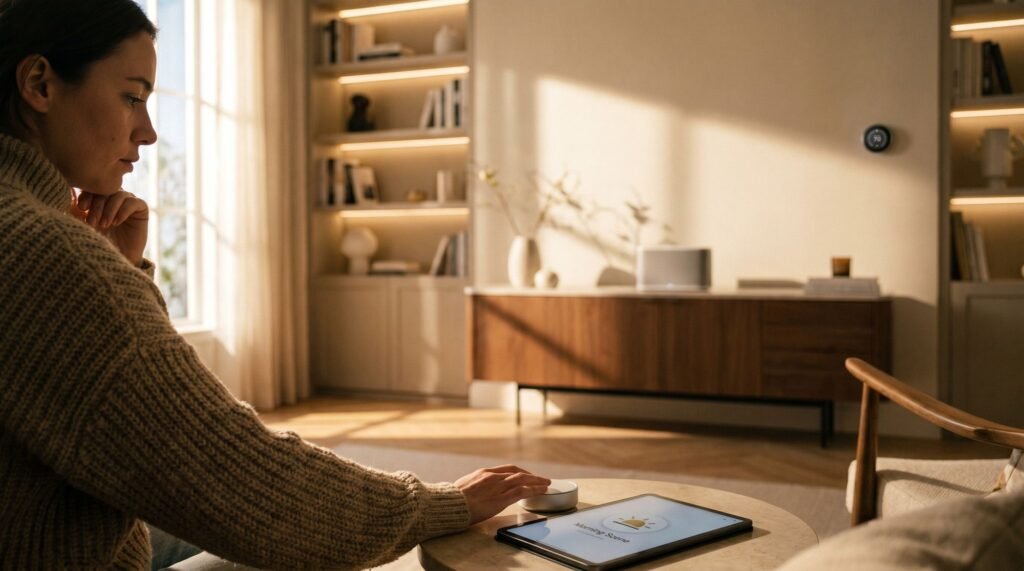
Beyond Convenience: How Smart Home Technology Is Redefining Life
The Shift from Gadgetry to Holistic Living In 2025, smart homes have evolved from gadgets into intuitive systems that quietly enhance everyday life. Smart home technology in 2025 is no longer about controlling your lights from an app — it's about building a home that thinks alongside you. The early days of smart homes were defined by novelty: voice assistants answering trivia questions, app-controlled thermostats that still required manual scheduling. That era is closing. What's replacing it is a fundamentally different relationship between people and their living spaces — one driven by proactive AI that anticipates needs rather than waiting to be told what to do. A home that dims the lights before you realize you're tired isn't a gadget. It's a system. Household adoption reflects this maturity. Smart home technology is projected to reach a 77.6% household penetration rate by 2025, signaling that this shift has moved well beyond early adopters. The tipping point isn't just technological — it's cultural. Consumers are no longer asking "what can this do?" They're asking "how does this fit into my life?" As Greg Walker, CEO of ASHB, puts it: "People want technologies that are intuitive, sustainable, and enhance daily life — not just add convenience." That distinction matters enormously. The most sophisticated smart home systems today are designed to be invisible — running quietly in the background, learning household patterns, and making micro-adjustments that users rarely notice but consistently benefit from. The less you interact with your home's technology, in many ways, the better it's working. This push toward seamless, background intelligence sets the stage for a broader conversation about energy autonomy and what it means to live sustainably in 2025. Reclaiming the Grid: The New Era of Energy Autonomy Adaptive climate control and energy dashboards help homes cut energy use by 20–30% while reducing carbon footprint. Smart homes are quietly becoming one of the most powerful tools in the fight against household energy waste — and the financial savings are just as compelling as the environmental ones. Understanding how smart home technology will change lives means looking beyond convenience to something more structural: energy autonomy. Occupancy-sensing lighting and AI-driven climate control remove the single biggest variable in household energy waste — human error. Lights no longer burn in empty rooms. Thermostats no longer cool houses that nobody is in. The system simply adapts, continuously, without requiring anyone to remember anything. The scale of that impact adds up fast. Research indicates that fully integrated smart homes can reduce annual energy consumption by 20% to 30%, while the average household can cut its carbon footprint by 500kg to 700kg of CO2 per year through smart home automation alone, according to findings highlighted by the University of Delta. That positions smart homes not as a lifestyle upgrade, but as a genuine participant in the broader green energy transition. Savings Breakdown — What Automation Actually Delivers: Lighting: Occupancy sensors cut lighting energy use by an estimated 30–40% HVAC: Adaptive scheduling reduces heating and cooling costs by up to 20% Standby power: Smart plugs eliminate phantom loads, saving $100–$200 annually Net CO2 reduction: Up to 700kg per household, per year The bigger picture is that millions of connected homes operating at this efficiency level represent a meaningful shift in national energy demand — one that supports renewable grid stability by flattening consumption peaks. For homeowners, the payoff is lower utility bills and a smaller footprint. For the grid, it's reduced pressure during high-demand periods. That dual benefit is what makes smart home automation worth taking seriously — and it's only one dimension of how this technology is reshaping daily life, including for one of the most vulnerable segments of the population. The Future of Aging: Independence Through Intelligence Proactive monitoring helps older adults live safely and independently while keeping technology in the background. Smart home automation is quietly becoming one of the most powerful tools for helping older adults live safely, confidently, and on their own terms. For decades, "aging in place" largely meant medical alert buttons and occasional check-in calls. That picture has changed dramatically. Today's systems move well beyond reactive alerts — detecting subtle changes in movement patterns that might signal a fall risk before an incident occurs, monitoring sleep quality, and flagging irregular routines that could indicate a health concern. The shift from reactive care to proactive monitoring is the defining upgrade of this generation of smart home technology. The psychological impact of that shift matters just as much as the practical one. Research published by the Journal of Medical Internet Research found that smart home systems significantly improve quality of life for older adults by enhancing "future security" and "achieving in life" domains — two pillars closely tied to a sense of control and purpose. When a home responds intelligently to a person's needs without requiring constant manual input, it reinforces autonomy rather than signaling dependency. In practice, this means a senior's home can notify a family member if the morning routine looks unusually different, adjust lighting automatically to reduce fall risk at night, and manage medication reminders without any effort from the resident. The technology recedes into the background, and the person stays in the foreground — which is exactly where they belong. It's worth noting, however, that adoption still faces real barriers: cost, technical literacy, and installation complexity can limit access for those who need it most. As those hurdles lower, the same intelligence shaping energy autonomy in modern homes is now extending its reach into personal safety — a natural segue into how smart home systems are redefining security itself. Smart Home Security: Beyond the Video Doorbell Modern security is a predictive, layered system — from leak sensors to AI-driven perimeter monitoring. Most people still think of home security as a camera on the front door — but truly integrated smart home devices have made that definition dangerously outdated. Modern smart home security isn't reactive; it's a predictive, layered system that acts before damage occurs. The old model
Beyond Convenience: How Smart Home Technology Is Redefining Life Read Post »