
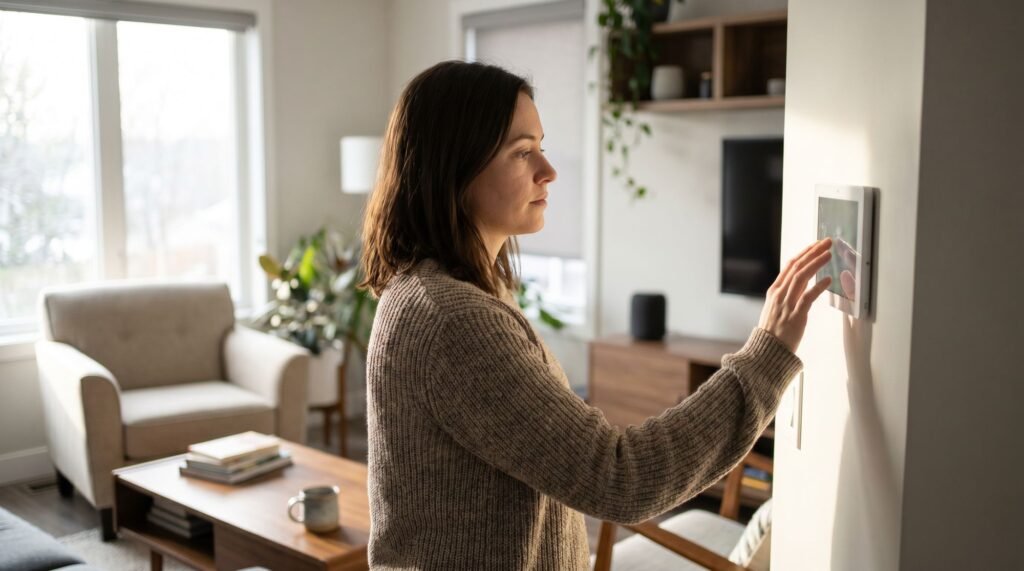
Why Every Smart Home Needs a Dedicated Controller
The Death of the App-Centric Home Migrating from fragmented mobile apps to a dedicated smart home control panel completely transforms daily household automation. <p>I’ve spent the last decade chasing the dream of a "seamless" smart home, and for years, my reality was a cluttered folder on my iPhone titled “Home.” Every time I wanted to adjust the porch lights or check the front door lock, I was met with a loading spinner and a different UI. It wasn't just a minor inconvenience; it was a systemic failure of <strong>smart home automation</strong>. When your internet blips and your "smart" switch stops responding, or when you have to explain to a guest which of the four apps controls the guest room fan, you realize you don't have a smart home—you have a digital chore list.</p> <p>The pivot point for me came when I migrated my 40+ devices to a dedicated <strong>home automation hub</strong>. Moving away from cloud-dependent apps to a local <strong>smart home controller</strong> changed the math of my daily life. In 2025, the industry has finally reached a consensus: the "app-for-everything" model is dead. To build a system that actually saves time and energy, you need a central brain—a <strong>smart home control panel</strong> or hub that orchestrates the <strong>Matter protocol</strong>, Zigbee, and Z-Wave devices into a single, cohesive environment that works even when the Wi-Fi doesn't.</p> <p><strong>A smart home built around separate apps isn't truly smart — it's just complicated.</strong> Picture this: you wake up, reach for your phone, and cycle through five different apps before your morning routine is even underway. One for the lights, another for the thermostat, a third for the security camera, a fourth for the door lock. By the time you've dimmed the bedroom lights, your coffee is cold.</p> <p>This is the reality for millions of homeowners today. The average connected home now runs more than ten devices across competing ecosystems, and the friction compounds fast. Voice assistants help at the surface level — "turn off the kitchen lights" works fine — but they fall apart the moment automation logic gets more nuanced than a single command. Scheduling a scene that gradually shifts lighting temperature while adjusting the HVAC and locking the front door at sunset? That's beyond what a voice prompt can reliably orchestrate.</p> <p>The real problem is a category gap. As <a href=”[https://www.youtube.com/watch?v=dSw_WVzIsyo](https://www.youtube.com/watch?v=dSw_WVzIsyo)” target=”_blank” rel=”noopener noreferrer”>Elkayan Tech highlights</a>, <strong>smart home automation centralizes the control of multiple home technologies through a single screen, greatly simplifying control and improving the user experience.</strong> The industry is finally shifting from simply <em>connecting</em> devices to genuinely <em>integrating</em> them — and that shift demands something more capable than an app drawer.</p> <p>That something is a dedicated <strong>home automation hub</strong>: a purpose-built controller that acts as the symphony conductor of your entire ecosystem. To understand why it changes everything, it helps to know exactly what one does under the hood.</p> <h2>What a Smart Home Controller Actually Does</h2> A dedicated home automation hub operates locally to process automation routines, translate protocols, and ensure complete data privacy. <p>A dedicated <strong>smart home controller</strong> is fundamentally different from a smartphone app — it's a local brain that runs your home's logic independently, around the clock.</p> <p>The distinction matters because apps depend on cloud servers, manufacturer uptime, and a stable internet connection. A controller doesn't. Here are its three core functions:</p> <ul> <li><p><strong>Local processing:</strong> Automation routines execute on your hardware, not a remote server. If your internet goes down, your lights still turn on at sunset and your door locks at midnight.</p> </li> <li><p><strong>Protocol translation:</strong> A controller bridges devices that speak different languages — Zigbee sensors, Z-Wave locks, and Thread-enabled bulbs can all communicate through a single hub rather than living in isolated silos.</p> </li> <li><p><strong>Advanced logic:</strong> Complex "if-this-then-that" scenarios — like dimming lights when a motion sensor detects sleep, then triggering the thermostat — go far beyond what a standard app allows.</p> </li> </ul> <p>There's a fourth function that often gets overlooked: <strong>data privacy</strong>. When automation logic runs locally, your usage patterns — when you wake up, which rooms you use, when you leave the house — never leave your home network. That's a meaningful advantage over cloud-dependent platforms that aggregate behavioral data on remote servers.</p> <p><strong>A controller is what transforms a collection of smart gadgets into a genuinely unified system.</strong> It holds the logic, manages the protocols, and keeps everything running even when the outside world is unavailable. Understanding what a controller does under the hood makes the next question obvious — what communication standards should it actually support? That's where the 2025 protocol landscape becomes crucial.</p> <h2>The 2025 Standard: Matter, Zigbee, and Local Control</h2> <p><strong>Smart home automation in 2025 is defined by one central tension: the push for universal compatibility versus the reality of fragmented legacy hardware.</strong></p> <p><strong>Matter is the closest thing the industry has to a universal language.</strong> Backed by Apple, Google, Amazon, and hundreds of device manufacturers, the Matter protocol allows a single device to work natively across competing ecosystems without workarounds or third-party bridges. For the first time, a smart lock certified for Matter doesn't care whether your hub prefers one voice assistant over another — it just works.</p> <p>That said, Matter doesn't make older protocols obsolete. <strong>Zigbee and Z-Wave remain the workhorses of low-power mesh networking</strong>, particularly for battery-operated sensors, leak detectors, and door contacts that need to communicate reliably for years without draining a battery. These mesh networks route signals through multiple devices, dramatically improving range and resilience in larger homes — something Wi-Fi-based Matter devices can't yet replicate at the same power efficiency.</p> <p>Meanwhile, platforms like Home Assistant have attracted a fast-growing community of users who want complete data ownership and local processing. Rather than routing commands through a manufacturer's server, a locally controlled setup keeps every automation decision on hardware inside your home — a critical advantage when a company discontinues a cloud service.</p> <p><strong>A dedicated controller that supports Matter, Zigbee, and local protocols future-proofs your home against shifting manufacturer standards</strong> — protection that pure
Why Every Smart Home Needs a Dedicated Controller Read Post »