
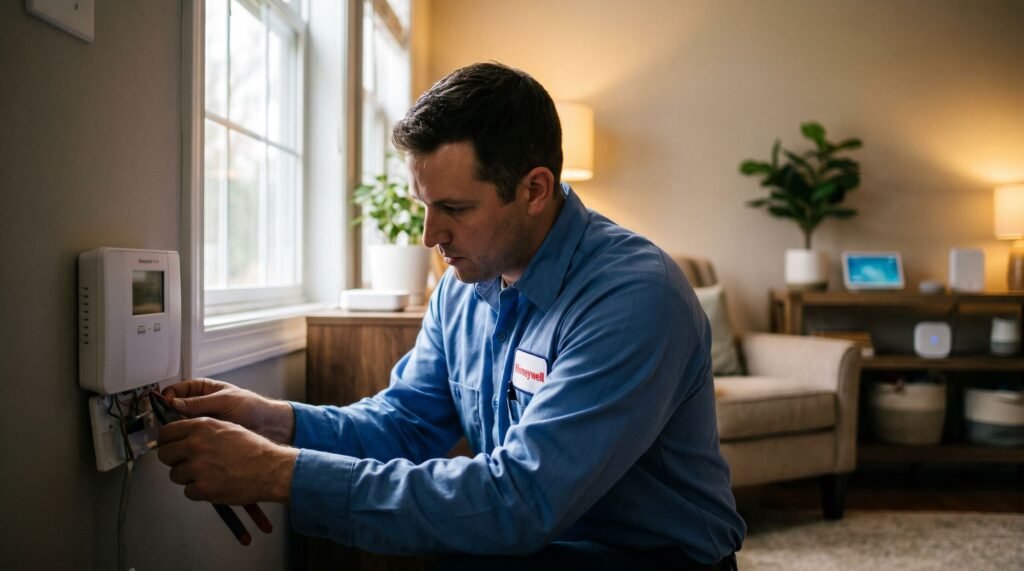
Why the Honeywell Security System Still Sets the Standard
The Evolution of Trust: From Ademco to Honeywell Resideo If you’ve ever been startled awake at 2 a.m. by the low-battery chirp of a cheap DIY sensor or, even worse, discovered your "smart" camera failed to catch a porch pirate due to a Wi-Fi glitch, you know the unsettling feeling of unreliable household security systems. After years of auditing home setups, I've found that the most common issue isn’t a lack of features but a lack of fundamental reliability. We've been conditioned to trade solid infrastructure for convenience, installing plastic hubs that resemble toys more than life-safety equipment. This leaves homeowners questioning whether their honeywell security system or an old ademco alarm system was the "old-school" gold standard they should have never abandoned. That legacy is why I still recommend Honeywell Resideo. While the tech world pursues the next flashy app integration, Honeywell has spent decades refining the "boring" parts of security: hardwired resilience, encrypted signals, and panels like the honeywell vista 20p alarm system that simply do not fail. Transitioning from the original Ademco engineering to modern Resideo kits hasn't been just a corporate rebranding; it’s been an evolution of professional-grade hardware that respects the high stakes of home defense. If you're tired of constantly troubleshooting your security systems for home, it’s time to explore why this architecture remains the industry benchmark. Few names carry more weight in the security industry than Honeywell — a brand built on decades of professional-grade hardware that has protected homes long before DIY alarm kits became a weekend project. The story begins with Ademco, founded in 1929 as the Alarm Device Manufacturing Company. Ademco essentially wrote the rulebook on hardwired alarm panels, which Honeywell later acquired, integrating that engineering legacy into what became the Honeywell Home and, later, Resideo lineup. Understanding that lineage is crucial because the DNA of those original panels — their reliability, their extensive zone support, their installer-grade architecture — lives on in today’s products. Honeywell Home products are installed in millions of homes worldwide, according to Resideo — a footprint that answers the "does Honeywell have a security system?" question definitively. This isn't a startup experimenting with smart locks; this is a company ranked the 4th most trusted home security brand in a 2024 national study of over 4,400 consumers. That trust wasn't built on marketing but on hardwired sensors that still outperform wireless alternatives in high-stakes environments, on panels engineered for professional installation, and on a support network that spans decades. A Honeywell security system signifies a commitment to infrastructure that consumer-grade, plug-and-play devices simply can't match — a distinction worth examining closely, starting with the flagship hardware that makes it possible. Hardwired Reliability: The Honeywell Vista 20P and Series Kits The Vista 20P remains one of the most capable hardwired control panels available — a benchmark for residential and light-commercial security that competing approaches have struggled to match. At its core, the Vista 20P is a hybrid control panel, meaning it supports both hardwired and wireless zones within a single system. According to Alarm Grid, the panel handles up to 48 zones of protection, giving installers the flexibility to mix physical wire runs with wireless sensors as coverage needs evolve. That architectural flexibility is a significant practical advantage: a homeowner can start with wired perimeter sensors on doors and windows and then expand into interior motion detection wirelessly — without replacing the panel. Hardwired sensors are still the preferred choice for high-security environments for a straightforward reason: there are no batteries to fail and no radio frequency signals to degrade. In practice, a wired connection delivers consistent, tamper-resistant communication between the sensor and the panel, which matters in settings where reliability cannot be compromised. This is why the Vista platform is also widely deployed as a Honeywell fire alarm system backbone in residential builds where life-safety compliance is the priority. For homeowners pursuing comprehensive coverage from day one, Resideo's Vista Series Alarm System Kits bundle the panel with essential sensors, keypads, and communication modules: Vista 20P control panel — the 48-zone hybrid hub Alpha keypad — full-featured, user-friendly interface Door and window contacts — wired perimeter sensors Passive infrared motion detector — interior zone coverage Siren/bell output — onboard alert capability Communication module — enabling central station monitoring Kit availability makes professional-grade deployment accessible without sourcing components individually — a notable advantage for security dealers and informed DIY installers alike. The Vista 20P's architecture sets a strong foundation, but hardwired reliability is only part of the modern security equation. The next challenge — building equally robust protection without wire runs — is where Honeywell's ProSeries platform steps in. Wireless Without Compromise: The ProSeries Platform The ProSeries platform represents a genuine leap forward — not just an incremental upgrade to wireless home security, but a rethinking of what encrypted, integrated protection should look like. Where legacy systems left wireless signals vulnerable to interception, the ProSeries addresses that gap head-on. All SiX and PROSiX sensors communicate using 128-bit AES encryption — the same standard used in financial and government data systems. That level of protection matters because unencrypted wireless signals from DIY competitors can be jammed or spoofed with relatively inexpensive hardware. For homeowners who upgraded from a hardwired setup like the Honeywell Vista 20P alarm system, the encryption gap between professional and consumer-grade wireless is one of the most compelling reasons to stay within the professional ecosystem. "The new ProSeries Platform combines three critical elements — security, fire safety, and smart home control — in an easy-to-use, all-in-one solution." — Stephen Wheeler, SDM Magazine Smart home integration is built in, not bolted on. The ProSeries supports Amazon Alexa voice control and connects with broader smart home ecosystems, allowing homeowners to arm or disarm the system, check sensor status, and automate routines without switching between apps. That convergence of security, encryption, and smart home control points naturally toward something even broader — because a truly protected home isn't only secured against intrusion. Integrated Fire Safety: More Than Just
Why the Honeywell Security System Still Sets the Standard Read Post »