
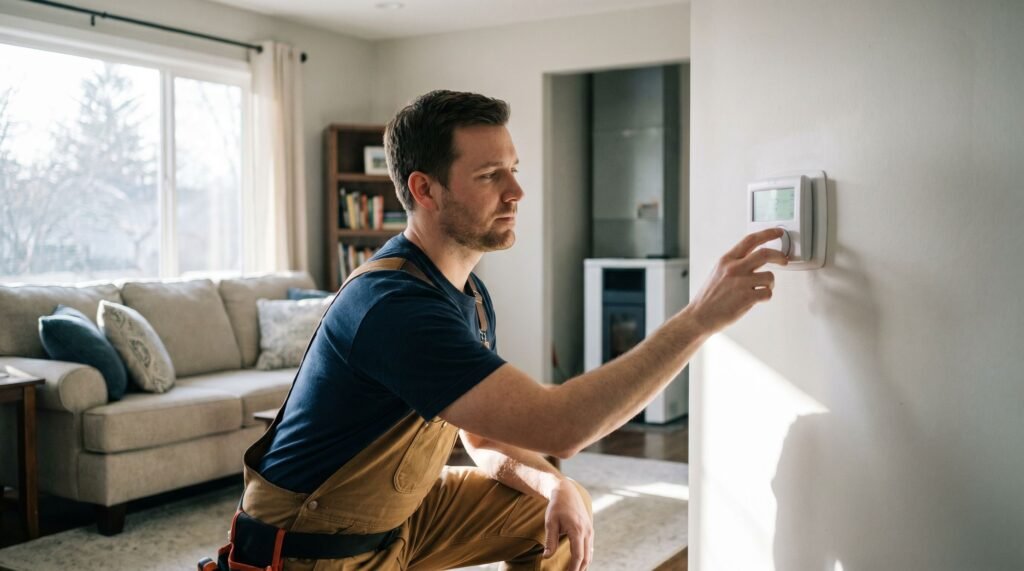
How to Tell if Your Thermostat Is Actually Bad
Why Your Thermostat Is the Most Likely Culprit There’s a specific kind of frustration that sets in when you wake up at 2:00 AM in a sweltering bedroom, only to look at your thermostat and see it stubbornly claiming the house is a cool 68 degrees. You start running through the "nightmare" scenarios: is the compressor shot? Has the furnace finally given up? For most homeowners, that blinking screen feels like the first sign of a multi-thousand-dollar repair bill that’s about to wreck the monthly budget. At Hyvoxa, we’ve walked into countless homes where families were ready to replace their entire HVAC system, only for our diagnostic tools to reveal a simple $40 wiring fault or a decade-old sensor that finally lost its calibration. In my years of field experience, I’ve learned that the thermostat is the most overlooked—yet most frequent—cause of system "failure." Before you panic-call a technician or resign yourself to a cold winter, let’s look at the actual warning signs I use to determine if a thermostat has truly reached the end of its life. Your thermostat is the brain behind every heating and cooling decision your HVAC system makes — and when that brain misfires, the whole house suffers. Most homeowners instinctively blame the furnace or AC unit when temperatures feel off. In practice, the thermostat is almost always worth investigating first. It acts as the central communication hub, sending signals that tell your system when to run, when to stop, and at what capacity. A breakdown anywhere in that signal chain can mimic a much more serious mechanical failure. The good news: many thermostat issues trace back to simple maintenance failures — dead batteries, loose wiring, or dust buildup — rather than a broken unit that needs replacing, according to This Old House. That single statistic should shift your first instinct from "call a technician" to "run a quick diagnostic." One of the most reliable early checks is the 5-degree test: manually raise or lower your set temperature by at least 5°F and listen for your system to respond within a minute or two. No response is a meaningful signal that something is wrong. Knowing how to tell if a thermostat is bad starts with exactly this kind of simple, hands-on check before you ever open a panel or pick up a phone. The sections ahead walk through five unmistakable warning signs that your thermostat — not your HVAC equipment — is the real problem. The 5 Unmistakable Signs of a Bad Thermostat Recognizing the signs of a bad thermostat early can save you hundreds of dollars in unnecessary HVAC repairs down the line. Blank or unresponsive display. If your thermostat screen goes dark or stops responding — even after fresh batteries — the internal components may have failed. This isn't a power glitch; it may indicate a deeper issue with the unit. No response to manual adjustments. According to Carrier, a thermostat that fails to respond when you manually raise or lower the temperature is a primary indicator of a faulty sensor or internal wiring failure. In practice, try bumping the set point up or down by 5 degrees — your system should kick on within a few minutes. If it doesn't, the thermostat is a likely suspect. System that won't shut off. A heater or AC running continuously without cycling down points to a thermostat that has lost its ability to signal "target reached." This constant runtime drives up energy bills fast. Visible corrosion on wiring or contacts. Opening the thermostat cover and finding rust, greenish buildup, or loose wire connections is a clear red flag, as explained in this troubleshooting breakdown. Frequent loss of programmed settings. If your schedules keep disappearing, the internal memory may be failing — and an unreliable thermostat means an unreliable home comfort system. Once you've identified these symptoms, the next question becomes more nuanced: even a thermostat that appears to be working can still be causing problems — especially when the temperature it displays doesn't match what you actually feel. When Your Home Temperature Doesn't Match the Reading A thermostat that displays 70°F while your room feels noticeably warmer is one of the most telling faulty thermostat symptoms homeowners overlook. Thermostat placement is often the hidden culprit. When a thermostat sits in direct sunlight, near a drafty window, or above a heat-producing appliance, it reads the localized air temperature around it — not the actual temperature of your living space. That localized reading skews the data your HVAC system acts on, creating a persistent gap between what the display shows and what your body feels. Symptom What It Feels Like Likely Cause Room feels warmer than displayed Stuffy or uncomfortable despite “correct” reading Thermostat in direct sunlight or near a heat source Room feels cooler than displayed Chilly even when system shows it’s reached setpoint Thermostat near a drafty exterior wall or vent System cycles on and off rapidly HVAC runs briefly then shuts off, repeating frequently Miscalibrated sensor triggering short-cycling Short-cycling — where the HVAC turns on and off in rapid succession — is a classic sign of a miscalibrated thermostat, according to American Standard Heating & Air Conditioning. The sensor reads a temperature it hasn't actually achieved and cuts the system off prematurely. Aging sensors can compound these problems. Over time, the internal temperature sensor loses sensitivity, producing readings that drift further from reality with each passing year. That drift starts subtly — you might not notice it at first — but it's worth understanding just how predictable that decline actually is. The 10-Year Rule: Understanding Thermostat Lifespan Age alone can answer the question of how can I tell if my thermostat is bad — because even a screen that lights up can hide years of internal decay. Most modern digital thermostats have a functional lifespan of roughly 10 years. After that threshold, the internal components — temperature sensors, capacitors, and circuit boards — begin to degrade in ways that aren't visible from the
How to Tell if Your Thermostat Is Actually Bad Read Post »