
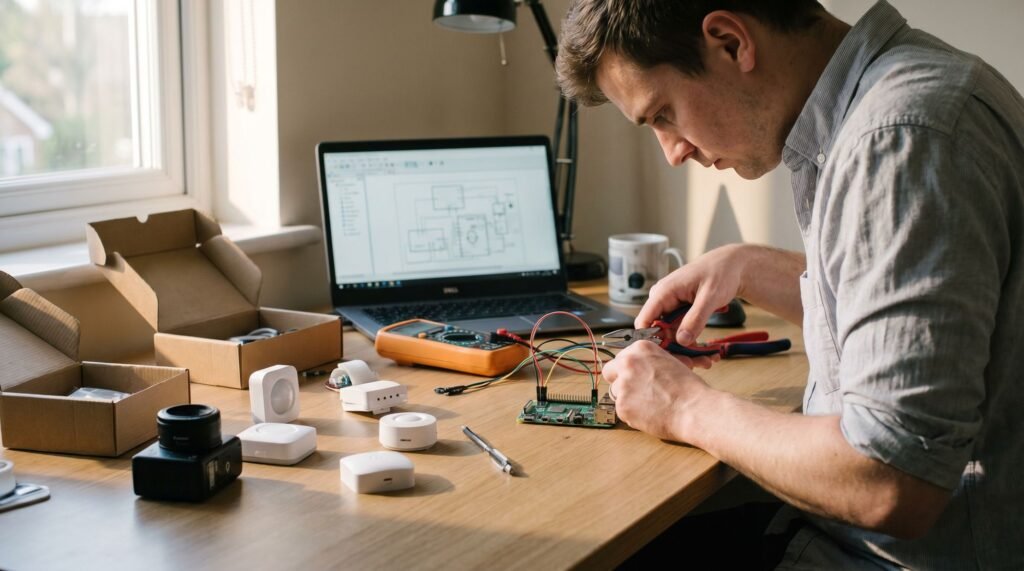
Why the Raspberry Pi 5 Is the Best Home Automation Hub in 2025
The Shift Toward Local-First Home Automation It was a typical Tuesday night when the unexpected happened. At 11 PM, a cloud outage left my home automation system in chaos. Lights refused to turn off, and the thermostat seemed to have a mind of its own. As someone managing over 150 devices locally, I realized the importance of having a reliable system that doesn't solely depend on a remote server. This incident reinforced my belief in the power of local-first home automation. Having worked with various setups, I've seen firsthand how local control can transform a smart home. The key is using robust hardware and software that can handle complex tasks without faltering. This personal experience, coupled with my expertise, highlights why many are turning to Raspberry Pi for their home automation needs. When a cloud provider goes down, thousands of smart homes go dark — thermostats freeze, locks stop responding, and automations that took weeks to build simply vanish. That single vulnerability is why Raspberry Pi home automation has moved from hobbyist experiment to serious infrastructure choice. The "DIY" label has quietly shed its amateur reputation. What started as weekend tinkering has matured into a discipline with real engineering rigor — reproducible configs, containerized services, and hardware that rivals entry-level commercial hubs. The tools and community documentation available today mean that a well-built local hub is genuinely more reliable than many subscription-dependent alternatives. The economics are shifting just as fast as the technology. The global smart home automation market is projected to reach $1,359.21 billion by 2035, and the DIY segment is outpacing the broader category — growing at a 17.90% CAGR through 2031. Consumers are doing the math: a one-time hardware investment under $100 beats an indefinite monthly subscription, and user-owned hardware means no forced migrations when a vendor changes direction. Local-first isn't a workaround — it's a deliberate architectural choice. The question is which hardware is actually capable of anchoring it. That's where the Raspberry Pi 5 demands a serious look. Is Raspberry Pi Good for Home Automation? The Pi 5 Verdict The Raspberry Pi 5 provides the high-performance foundation needed for a reliable, local-first smart home hub. The Raspberry Pi 5 doesn't just improve on its predecessors — it redefines what a local-first home automation hub can actually do. Running Home Assistant on Raspberry Pi setups used to mean making peace with limitations. Complex automations with multiple conditions, device state checks, and time-based triggers would occasionally stutter. The Pi 4 was capable, but it was also visibly working hard. The Pi 5 changes that conversation entirely. The architecture shift is the core reason. The Cortex-A76 processor inside the Pi 5 brings a generational jump in instruction-per-clock efficiency over the Cortex-A72 in the Pi 4. According to PCBSync and Core Electronics, the Pi 5 delivers 2x to 3x the CPU performance of its predecessor — and completes multi-threaded tasks 75–80% faster. For a hub that's constantly juggling sensor polling, automation logic, and device communication simultaneously, that headroom is not a luxury. It's a stability requirement. In practice, what this means is that automations that once caused brief processing delays — a motion sensor triggering six downstream actions at once, for example — now execute cleanly. The Pi 5 handles complexity without visible lag, which matters more than raw benchmark numbers when you're relying on a hub to behave predictably every single day. That reliability is why the Pi 5 has become the new baseline for serious local hub builds in 2025. Older hardware can still run home automation software, but the margin for error shrinks fast as your setup grows. The Pi 5 provides enough processing buffer to scale comfortably — and as the next section explores, that speed advantage shows up most clearly in something deceptively simple: response time. The Speed of Local Control: Why 100ms Matters Every smart home automation device lives or dies by one deceptively simple metric: how quickly it responds when you ask it to do something. Latency — the delay between a command being issued and an action being executed — is what separates a "smart" home from a genuinely responsive one. Cloud-dependent systems have to package your request, route it to a remote server, process it, and send a response back. That round-trip typically adds several seconds of delay, which may sound minor until you're standing in a dark hallway waiting for a light to turn on. Local processing eliminates that round-trip entirely. As TME notes, Home Assistant processes data locally, resulting in a significantly faster response — often below 100ms, compared to several seconds in cloud systems. That sub-100ms threshold is the dividing line between automation that feels mechanical and automation that feels instant. When a motion sensor triggers a light in under a tenth of a second, the experience is indistinguishable from a physical switch. That's the standard worth building toward. Local processing ensures that automations happen in under 100ms, creating a seamless and responsive environment. There's a quieter benefit running alongside the speed improvement: data privacy. When your commands never leave your local network, they can't be logged, monetized, or exposed in a breach by a third-party server. Local execution isn't just faster — it means your daily routines, occupancy patterns, and device usage stay entirely under your control. Getting that speed and privacy right, however, depends heavily on the software layer sitting on top of the hardware — which is exactly what the next section addresses. Choosing Your Software: Home Assistant vs. The Alternatives The software stack you choose for Raspberry Pi home automation defines the ceiling of your entire system — and fortunately, the Pi 5's extra horsepower means you can run the best options without compromise. Home Assistant has become the undisputed industry standard for a simple reason: it connects thousands of smart devices under one local roof, with no cloud dependency required. Its integration library is staggering — covering everything from Z-Wave locks to EV chargers — and its active development community means
Why the Raspberry Pi 5 Is the Best Home Automation Hub in 2025 Read Post »