
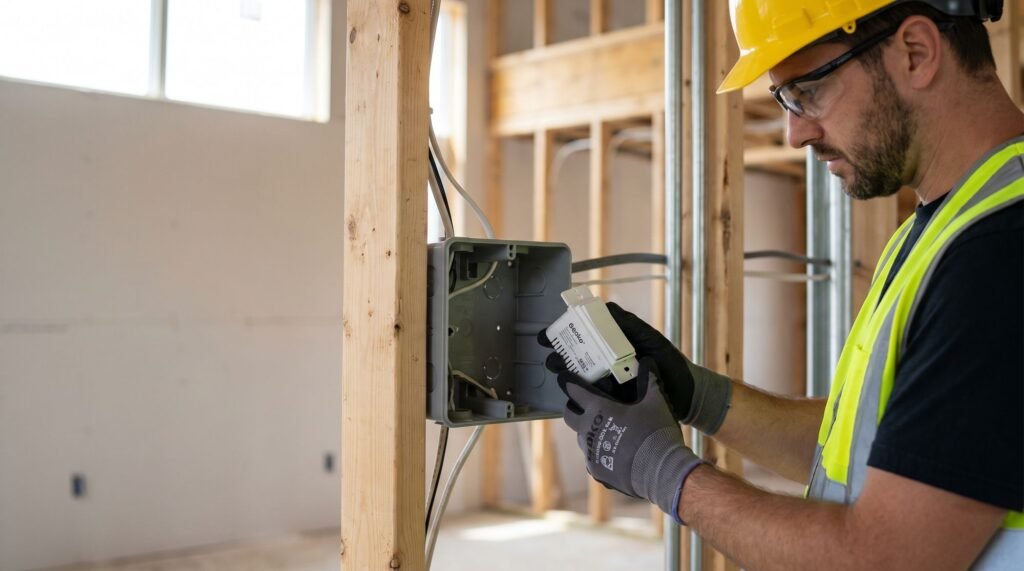
Deako Smart Switch: The Future of New Home Lighting
Beyond the Bulb: What a Deako Smart Switch Actually Does Deako smart lighting isn't a single device — it's an entire architecture built around one deceptively simple idea: the switch and the wiring are two separate problems. Most smart switches force homeowners into an all-or-nothing commitment. Swap out the whole unit, deal with exposed wiring, and hope you picked the right technology for the long haul. Deako flips that model entirely, starting at the wall. The foundation is the universal backbox — a standardized electrical housing that builders pre-install during construction before a single piece of drywall goes up. All the wiring stays permanently inside that backbox. What snaps into the front — the actual switch module — is completely interchangeable. Modular Lighting Architecture: A system design where the electrical infrastructure (backbox + wiring) is permanently fixed, while the user-facing switch module is a removable, swappable component requiring no electrical tools or exposed wire contact. That distinction matters for safety. Because the live wiring never leaves the backbox, homeowners can upgrade between a basic "dumb" module and a full smart module without touching a single wire. As Sound & Vision notes, "The lighting devices snap in and out of [the backbox] in about 5 seconds, letting you change from a 'dumb switch' to a 'smart switch' in no time." That 5-second swap is the real value proposition — and it hints at something bigger. The backbox is just the foundation; what you plug into it opens up a surprisingly capable connected system. That's where Deako's second-generation technology starts to get genuinely interesting. The Gen 2 Advantage: Magic Linking and Technical Evolution Deako's second-generation hardware didn't just refine the original concept — it fundamentally removed the friction points that kept smart lighting out of mainstream construction. The jump from Gen 1 to Gen 2 brought a noticeably sleeker physical profile alongside meaningful connectivity improvements. Where the original modules occasionally required manual pairing steps and offered more limited app responsiveness, Gen 2 tightened both the hardware tolerances and the wireless communication layer. The result is a switch that feels premium to the touch and responds with the reliability builders need to hand off a finished home without technical callbacks. The flagship innovation in this generation is Magic Linking — a proprietary technology that automatically configures multi-way lighting circuits without any manual programming. Multi-location setups, like the switches at the top and bottom of a staircase or at either end of a long hallway, have historically been one of the most labor-intensive parts of a smart lighting installation. According to the IoT M2M Council, Magic Linking handles that configuration automatically, detecting companion switches and establishing the circuit relationship on its own. The Deako Smart Switch app manages the initial handshake between devices, guiding homeowners through a setup process that requires no electrician and no line-by-line programming. Once the app completes that first connection, the switches communicate independently. Sleeker, lower-profile faceplate design compared to Gen 1 Improved wireless connectivity and faster response times Magic Linking for automatic 3-way and 4-way circuit pairing App-guided initial setup replacing manual programming steps No traveler wire rewiring required for multi-switch configurations That last point matters more than it might seem — and it's a big reason why builders are starting to see Deako not just as a feature upgrade, but as a structural decision worth making at the framing stage. Why Builders are Betting on Deako Infrastructure Deako's dominance in new construction isn't accidental — it's the direct result of a strategy that makes smart lighting infrastructure nearly invisible to builders until it becomes indispensable. The concept driving this growth is the "Smart-Ready" home, where Deako's modular backplates are wired into walls during the framing stage — before drywall, before fixtures, before any homeowner makes a single decision. The backplate becomes part of the structure itself. That means a buyer moving into a finished home can upgrade any switch from a standard dimmer to a fully connected smart device in under a minute, with zero electrician required. The house is smart before the buyer even decides to go smart. That workflow appeals enormously to production builders managing costs across hundreds of units. Partnerships with major builders — including D.R. Horton and Toll Brothers — reflect a shared incentive: modularity transfers the upgrade decision to the buyer, which reduces builder liability and compresses electrical labor costs during construction. Instead of running complex smart-wiring specs on spec homes, builders install a uniform backplate system and let the market sort out the rest. For anyone researching a Deako Smart Switch review, this builder-first design logic is often the detail that reframes the whole product. The scale that has resulted is significant. According to CBUSA, Deako's modular backplates are now installed in one out of every six new homes built in the United States — a market penetration figure that rivals established electrical infrastructure standards. 1 in 6 new U.S. homes is already Deako-wired. That installed base has compounding value. Every backplate in a new home is a future smart switch waiting to be activated — and as that footprint grows, so does the case for choosing Deako as a resale differentiator. The Resale Factor: Do Smart Switches Help Sell Homes? Smart lighting infrastructure isn't just a convenience upgrade — it's a measurable financial asset that moves homes off the market faster. According to Entrepreneur, homes equipped with Deako smart lighting sell approximately 20 days faster than those without. That kind of acceleration in a competitive market can represent thousands of dollars in carrying costs saved, and it signals something important: buyers aren't treating smart switches as a novelty. They're treating them as a baseline expectation. D.R. Horton, the largest homebuilder in the United States, deployed Deako switching infrastructure across more than 100,000 homes — a scale that effectively validated the technology as a standard feature rather than a premium add-on. Buyer psychology plays a significant role here. Modular switches read as "designed," not "retrofitted." When a prospective buyer walks through
Deako Smart Switch: The Future of New Home Lighting Read Post »